

Table of Contents
Introduction – How Software Turns from Idea to Reality
Every app, game, or website you use — whether it’s Instagram, Zomato, or Paytm — starts from a single idea. But how do these ideas transform into fully working software? The answer lies in the Software Development Life Cycle (SDLC).
The Software Development Life Cycle (SDLC) is a structured process used by software engineers to design, develop, test, deploy, and maintain high-quality software. It’s the blueprint of every successful project, ensuring that the software meets user needs, stays within budget, and is delivered on time.
Without SDLC, software development would be chaotic — teams would miss deadlines, quality would drop, and costs would rise. But with SDLC, every step has a defined goal and outcome.
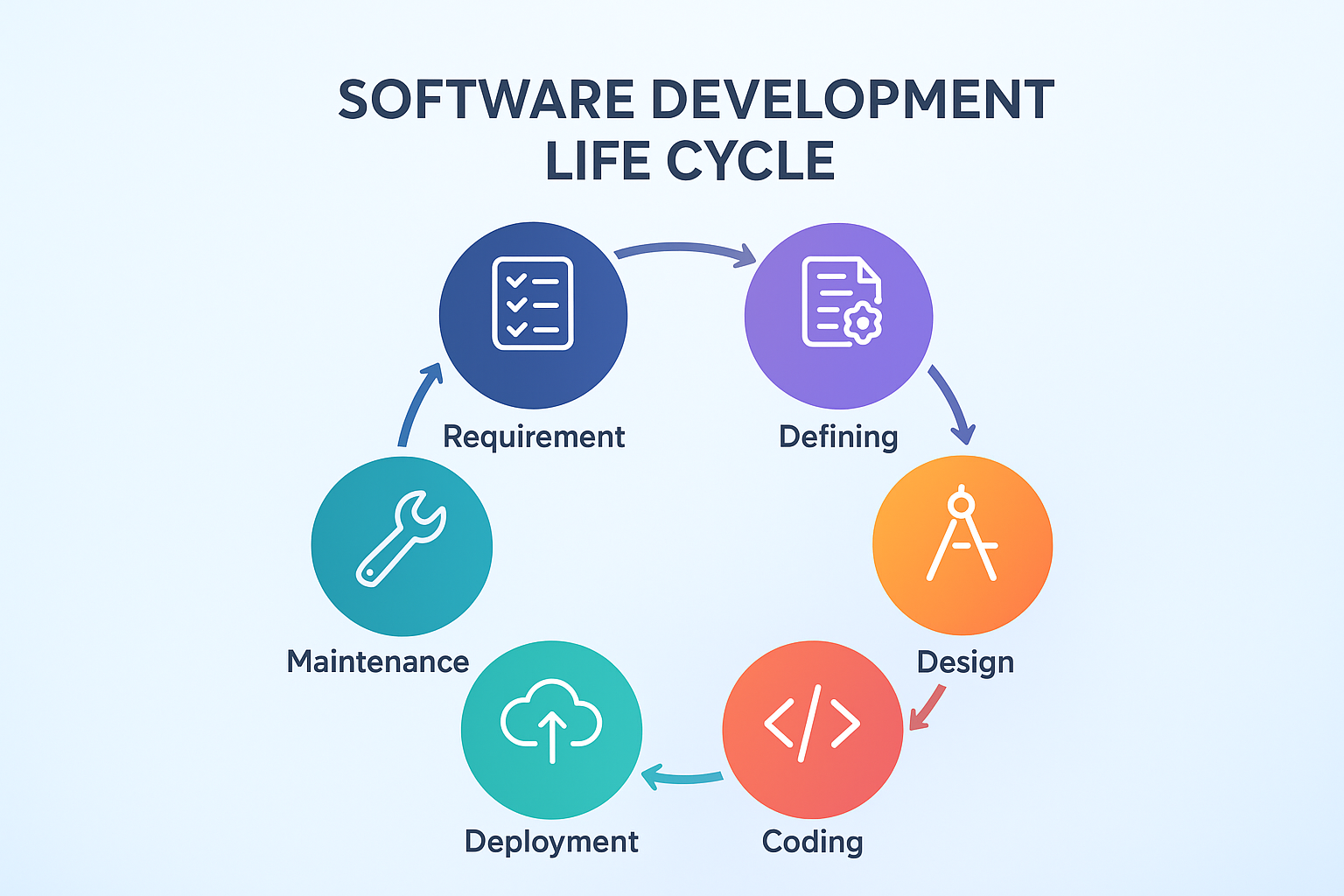
The Seven Phases of the SDLC
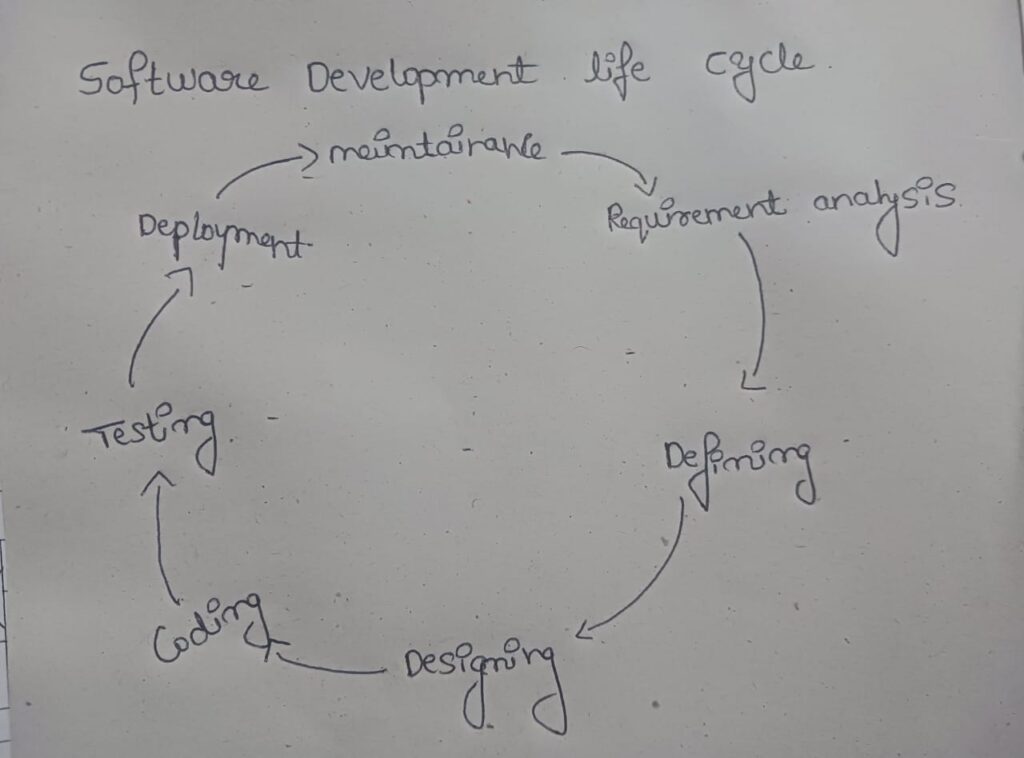
You can represent this as a circular or step-flow diagram in your handwritten notes.
Phases:
- Requirement Analysis
- Defining
- Designing
- Coding (Implementation)
- Testing
- Deployment
- Maintenance
Let’s understand each phase in depth.
1️⃣ Requirement Analysis
This is the foundation of any project. It involves understanding what the client or end-user wants.
- Teams collect information via interviews, surveys, and brainstorming sessions.
- Both functional (features) and non-functional (performance, scalability) requirements are noted.
- Deliverable: Software Requirement Specification (SRS) document.
Example: For a food delivery app, you identify needs like restaurant listings, order tracking, payment gateways, and user reviews.
Diagram Tip: Draw users, analysts, and arrows showing information flow toward the SRS document.
2️⃣ Defining
Once requirements are gathered, they must be clearly defined and approved by stakeholders.
- Define the project’s scope, objectives, and deliverables.
- Decide success metrics and acceptance criteria.
- Create a baseline for design and development teams.
Why it’s important: Without proper definitions, scope creep happens — features keep changing, causing delays.
Diagram Tip: Add a box labeled “Approved SRS → Design Phase.”
3️⃣ Designing
The system design converts requirements into a technical blueprint.
- Includes high-level design (HLD): architecture, modules, data flow, APIs.
- And low-level design (LLD): logic, algorithms, database schema, and component details.
Deliverables: Design documents, mockups, ER diagrams.
Example: For a food app, designing how login works, database for orders, and API integration.
4️⃣ Coding / Implementation
The design turns into working software.
- Developers write code using chosen languages and frameworks.
- Teams use version control (like Git) to manage changes.
- Continuous Integration (CI) tools automate building and testing.
Deliverable: Working application modules.
Best Practice: Follow coding standards and conduct peer reviews.
5️⃣ Testing
The software is verified to ensure it meets the requirements and has no bugs.
Testing types:
- Unit Testing
- Integration Testing
- System Testing
- Performance Testing
- Security Testing
- User Acceptance Testing (UAT)
Deliverable: Test cases, bug reports, and final QA sign-off.
Diagram Tip: Draw the testing pyramid from unit → integration → system → UAT.
6️⃣ Deployment
Once approved, the software is released to users.
- It may first go to a staging environment for final checks.
- Then deployed to production servers.
- Automated using CI/CD pipelines.
Deliverable: Released software, deployment documentation.
Example: Releasing the food delivery app to Play Store and App Store.
7️⃣ Maintenance
After launch, real users provide feedback, and bugs may appear.
- Teams issue patches, updates, and upgrades.
- Add new features or improve performance.
Deliverable: Updated versions and maintenance logs.
Diagram Tip: Show a loop back from Maintenance to Requirement Analysis (continuous improvement).
SDLC Models
Different projects require different approaches. Here are the main SDLC models with detailed explanations and sequences for your diagrams.
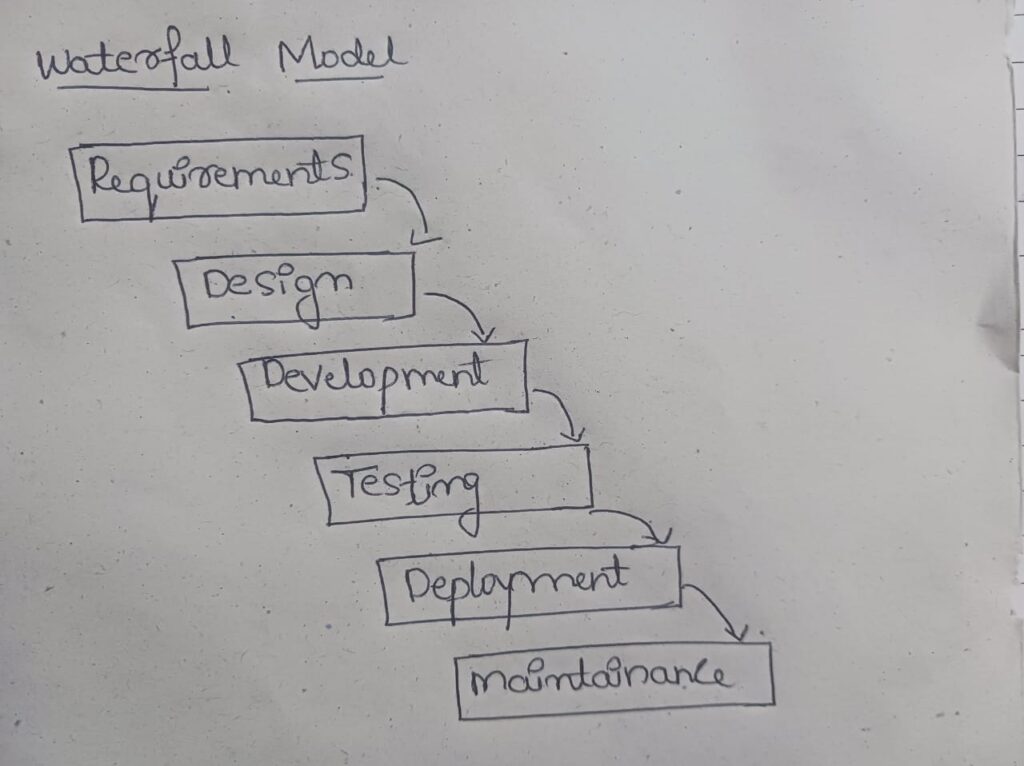
🔹 1. Waterfall Model
Sequence: Requirements → Design → Development → Testing → Deployment → Maintenance
Explanation:
- The oldest and most traditional SDLC model.
- Each phase must finish before the next begins.
- Documentation is crucial, and there is little overlap.
Advantages:
- Simple and easy to manage.
- Works well for projects with fixed requirements.
- Clear documentation.
Disadvantages:
- Difficult to go back to previous stages.
- Changes are costly and time-consuming.
Use Case: Banking systems, government or defense projects.
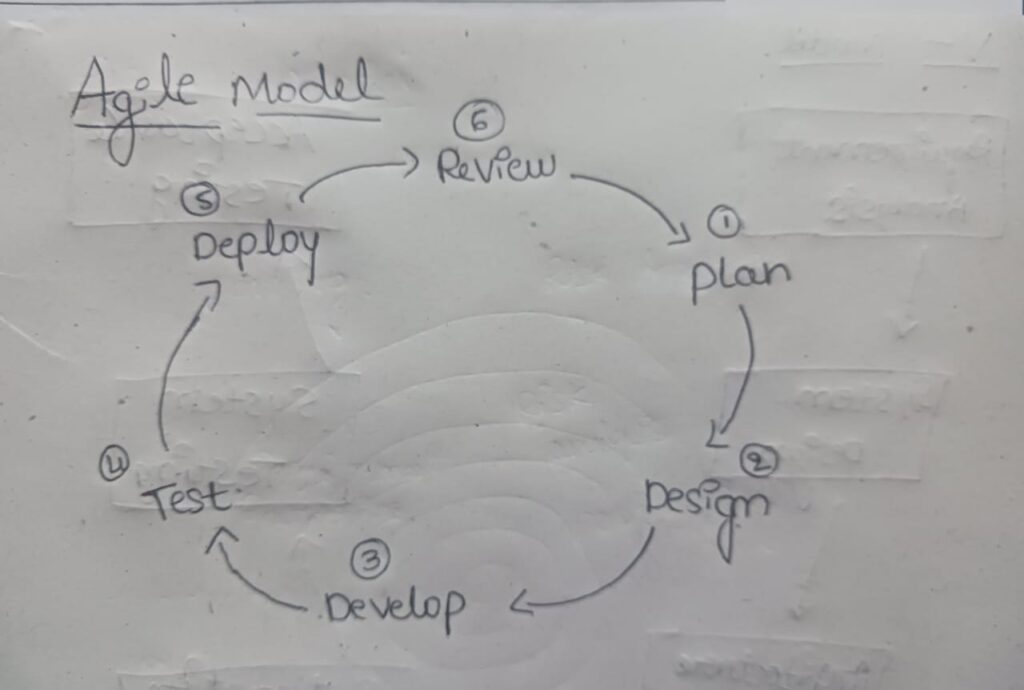
🔹 2. Agile Model
Sequence: Plan → Design → Develop → Test → Deploy → Review
Explanation:
- Agile divides development into short sprints (1–4 weeks).
- After every sprint, feedback is collected, and improvements are made.
- Focuses on collaboration, flexibility, and delivering working software quickly.
Advantages:
- Highly flexible and adaptive.
- Frequent releases increase customer satisfaction.
- Encourages teamwork and communication.
Disadvantages:
- Requires experienced teams.
- Can be hard to predict costs and time.
Use Case: Startups, mobile apps, and evolving web projects.
🔹 3. Iterative Model
Sequence: Planning → Design → Implementation → Testing → Evaluation → Next Iteration
Explanation:
- The system is developed in small sections (iterations).
- Each iteration adds features and improvements.
Advantages:
- Early working versions available.
- Easier to fix issues in early stages.
Disadvantages:
- Needs good planning.
- May require more resources.
Use Case: Enterprise applications or ERP systems.
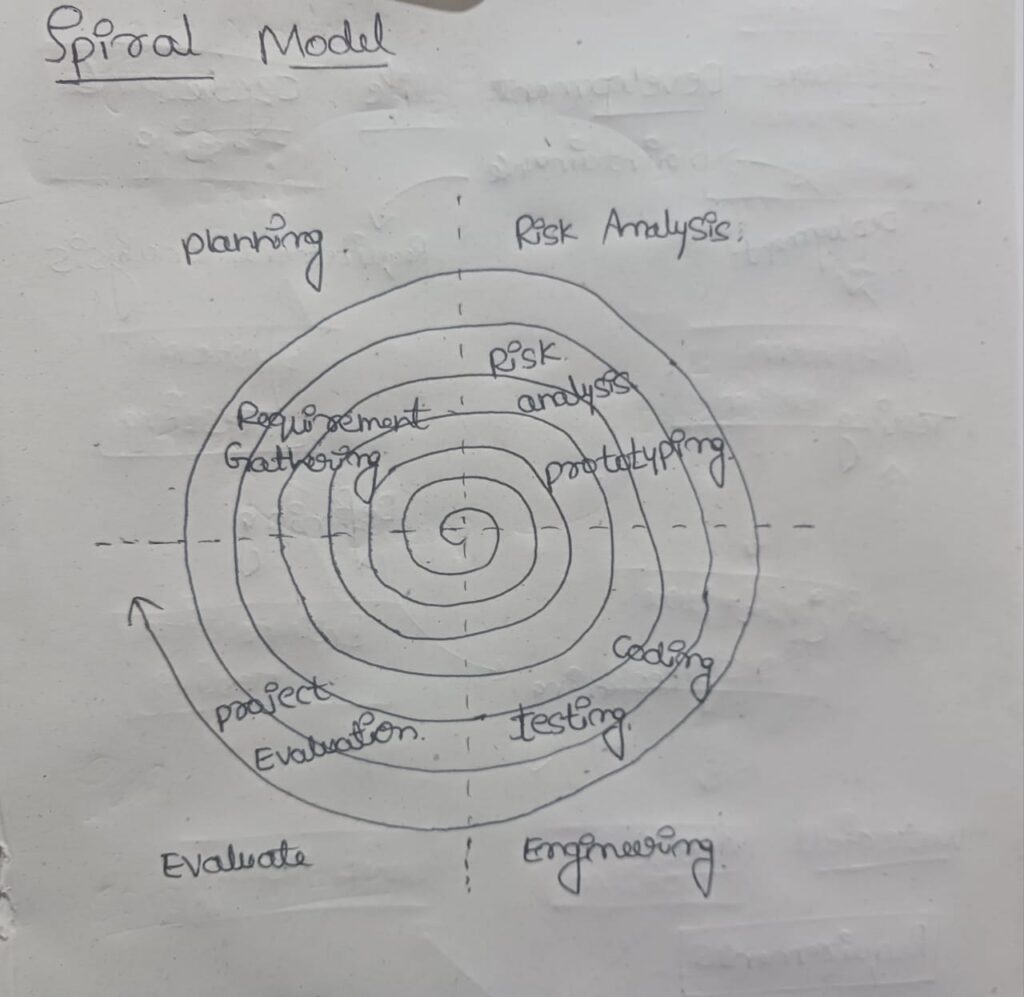
🔹 4. Spiral Model
Sequence: Planning & Requirement Gathering → Risk Analysis → Prototyping → Engineering (Coding) → Testing → Evaluation
Explanation:
- Combines iterative development with risk analysis.
- Each loop identifies and mitigates risks before moving ahead.
Advantages:
- Great for large, complex, or high-risk projects.
- Reduces potential failures by early detection.
Disadvantages:
- Time-consuming.
- Expensive due to continuous risk analysis.
Use Case: Aerospace, military, and large enterprise systems.
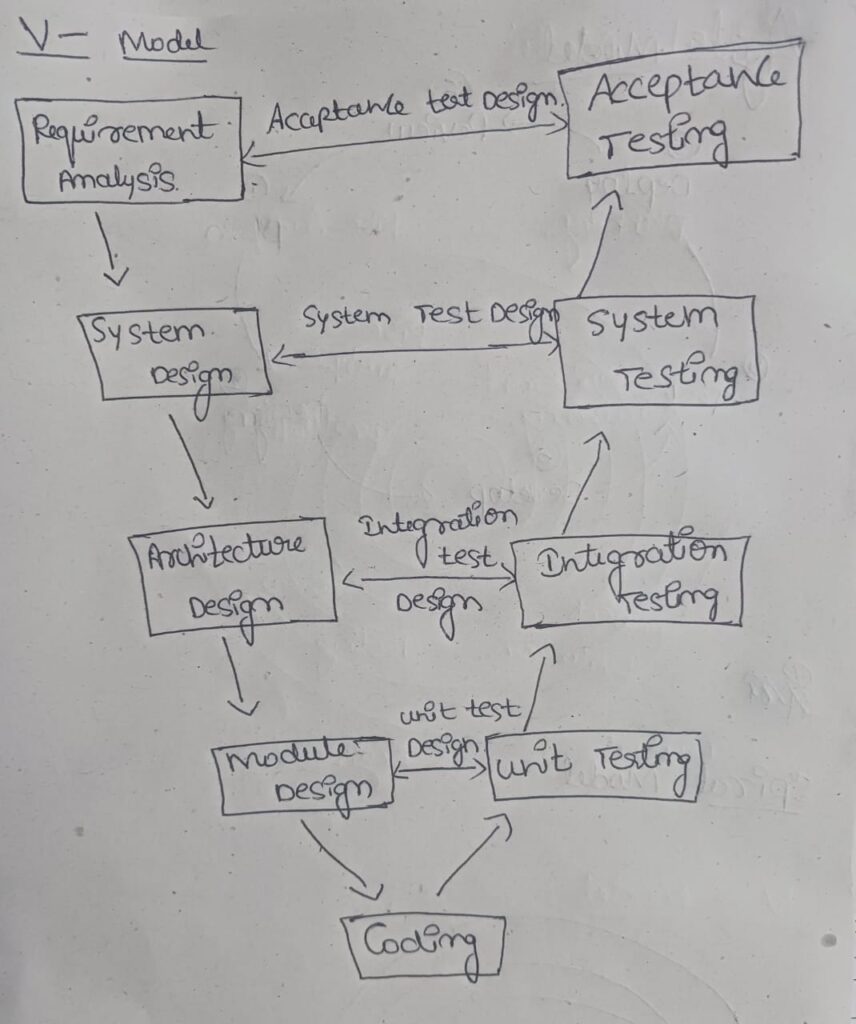
🔹 5. V-Model (Verification & Validation Model)
Sequence: Requirement Analysis → System Design → Architecture Design → Module Design → Coding → Unit Testing → Integration Testing → System Testing → Acceptance Testing
Explanation:
- Every development stage has a matching test phase.
- Emphasizes quality and validation.
Advantages:
- Strong focus on testing.
- Ideal for regulated industries.
Disadvantages:
- Not suitable for projects with frequent changes.
Use Case: Medical, automotive, and embedded systems.
🔹 6. Big Bang Model
Explanation:
- No specific process or plan. Developers start coding immediately with minimal documentation.
- Suitable for small, simple projects or learning experiments.
Advantages:
- Simple and fast for very small projects.
Disadvantages:
- High risk of failure for complex projects.
Use Case: Student projects or prototypes.
🔹 7. Prototype Model
Explanation:
- A working prototype is built early to show users what the final product will look like.
- Feedback from users helps refine requirements.
Advantages:
- Early user feedback.
- Reduces risk of building the wrong product.
Disadvantages:
- Can cause delays if prototypes are over-refined.
Use Case: UI-heavy applications, websites.
🔹 8. DevOps Model
Explanation:
- Combines development and operations.
- Focuses on continuous integration (CI) and continuous delivery (CD).
- Automates testing, deployment, and monitoring.
Advantages:
- Faster delivery.
- Continuous feedback loop.
Disadvantages:
- Requires strong DevOps culture and tools.
Use Case: Cloud-based platforms, SaaS systems like Netflix and Amazon.
Real-World Example — SDLC in Action
Imagine building a fitness tracking app:
- Requirement Analysis: Identify user needs (step counter, calorie tracker, heart rate monitor).
- Defining: Finalize app features and goals.
- Design: Plan UI/UX and data structure.
- Coding: Implement core features and backend logic.
- Testing: Ensure accuracy of data and performance.
- Deployment: Release app to app stores.
- Maintenance: Add new features like smartwatch sync.
FAQ Section
1. What is SDLC?
It’s the process followed by software teams to design, develop, test, and maintain software.
2. Which SDLC model is best?
Agile and DevOps are most popular today due to flexibility and speed.
3. What are the main phases of SDLC?
Requirement Analysis, Defining, Designing, Coding, Testing, Deployment, and Maintenance.
4. Why is SDLC important?
It ensures structured development, better quality, and reduced risk.
Conclusion – SDLC is the Backbone of Software Engineering
The Software Development Life Cycle (SDLC) gives structure and discipline to software engineering. It ensures every project — big or small — follows a path from idea to reality efficiently. Whether you choose Waterfall, Agile, Spiral, or DevOps, understanding SDLC helps you plan better, build faster, and deliver smarter.
Each model has its strengths, but the goal remains the same — to produce high-quality software that meets user expectations.
Further Reading
If you’d like to explore more about the Software Development Life Cycle (SDLC), check out these trusted external resources:
GeeksforGeeks — Software Development Life Cycle (SDLC)
You May Also Like
If you found this blog interesting, you might enjoy exploring more stories, tips, and insights in our